Showing posts with label Col du Tourmalet. Show all posts

Thursday, July 22, 2010

Rouge Report: Surviving the Assassins

Legend has it - covered in mud and sweat, and laboring to push his bike up the steep goat-track, he spat, "Assassins"*, at Tour officials. That was eventual 1910 Tour winner Octave Lapize cresting the summit 15 minutes behind first summit winner Gustave Garrigou. Perhaps Lapize's exclamation was really into the thin air at 2115 meters and directed at the silent geant Col du Tourmalet piercing the sky above the surrounding Pyrenees.

Today the only thing piercing the summit's thin air was Andy Schleck's outstretched fist as he crossed the line a wheel length ahead Alberto Contador. The rest of the peloton are still pedaling squares up the foggy face of the mountain's west slope - coming across the line in dribble and drabs. It will be nearly an hour before we know on whom the red light shines in the race for the Lanterne Rouge. Rumor has it that HTC-Columbia has formed a Lanterne Rouge Leadout Train to insure Bert Grabsch get's home under the time cut-off.

*****

Current Lanterne Rouge Bert Grabsch survived Tuesday's "Circle of Death" so took refuge in the company of a trio of his fellow HTC-Columbia riders to seek safety from any final Tourmalet assassins and finished 31:46 back on the day, enough to pry open his rest day margin in the race for rouge by an additional minute and a half over Adriano Malori. With little more than a few speed bumps worth of elevation on the flatish road Friday north to Bordeaux, it looks like we have a two man race for the little lantern with the German rider setting up a 75 year celebratory return to rouge. My only concern is Grabsch forms part of HTC's leadout train for the Manx missile and one twitch of wheels and it could be an Italian celebration in Paris. Here's where the race sits:
169Anthony Roux (Fra) Française des Jeux4:14:11
170Adriano Malori (Ita) Lampre-Farnese Vini4:23:14
171Bert Grabsch (Ger) Team HTC - Columbia4:26:56


*
(Some report the word was actually "Murderers".)

Tuesday, July 20, 2010

Rouge Report: "The Circle of Death"

Somewhere between a few hundred million and 6.3 billion of us populating our planet most humans lost our primordial priority - contesting for survival. Real survival, the kind where for example, your daily bread comes at the risky price of challenging large beasts which could turn the table and eat you. Survivors were immortalized on cave walls and in totems, they were heroes. Hardwired in us is the need to face deathly demons, survive the ordeal, so we invented sports and then imagined ridiculous challenges - Le Tour de France.

Exactly one hundred years ago now, director Henri Desgrange dispatched his trusted assistant Alphonse Steinès to determine the passabilty, better survivability, of sending single-sprocket riders over the spine of the Pyrenees. Steinès' liberally positive report (after nearly being lost in the snow) concocted an experiment that would be tested two months later on the Herculean Stage 10 of the 1910 Tour de France: four brutal climbs, peaking with the first ascent of the Col du Peyresourde (1569m), the Col d'Aspin (1489m), the Col du Tourmalet(2115m), and the Col d'Aubisque(1710m). A Tour legend was born. To the delight of Director Desgrange, the print press proved contributing accomplices to the legend by naming the new route that grueling day in the Pyrenees “The Circle of Death”, where hopes of a Tour de France victory go to die (Thursday that fate will be decided for Andy Schleck and Alberto Contador.)

A Circle of Death? Why?

In Desgrange's own words, "The ideal Tour would be a Tour in which only one rider survives the ordeal."


That ordeal, first for
Alphonse Steinès, included the now famous Col du Tourmalet, generally capped by cold and mist, crowning the Circle of Death. Ordeals of the Tourmalet pepper Tour lore. One story goes - arriving at the summit in 1947 Jean-Apo Lazaridès climbed off to wait for the others for fearing his 'ordeal' would include the challenge of Pyrenean bears. On the day I rode the Circle death had overtaken a local horse and vultures haunted the roadside scene - definitely inspiring this rider to pick up the pedal revs - cyclists are not the only ones challenged by the Circle of Death.

To be fair even generally uncompassionate Desgrange was apprehensive about the mountainous experiment; as a precaution, to protect perception of his race, he created a vehicle to rescue victims of the Circle and, in an extremely rare show of generosity, even allowed them to start the next stage, penalized of course. That vehicle was the voiture balai - Death's chariot was born - the broom wagon.

The Circle of Death wasn't quite as hungry today as in years past, but it did have an appetite, for two riders the journey was pockmarked by 'DNF'. For many in the peloton the Circle was more akin to the Bermuda Triangle; over 23 minutes adrift Sylvain Chavanel, Michael Rogers and Cadel Evans, all but vanished from camera view, leaving commentators to question if they had DNF'd.

One rider soared away from the mountains and apparently out of the Lanterne Rouge race, RadioShack's Dmitriy Muravyev, who once was considered a serious challenger for rouge. Going into the rest day in Pau things aren't sewn up:
159 David Millar (GBr) Garmin - Transitions 3:25:22
160 Nicki Sörensen (Den) Team Saxo Bank 3:26:42
161 Dimitri Champion (Fra) AG2R La Mondiale 3:27:19
162 Brett Lancaster (Aus) Cervelo Test Team 3:27:22
163 Daniel Lloyd (GBr) Cervelo Test Team 3:27:48
164 Manuel Quinziato (Ita) Liquigas-Doimo 3:29:15
165 Jeremy Hunt (GBr) Cervelo Test Team 3:30:01
166 Robbie McEwen (Aus) Team Katusha 3:32:26
167 Mirco Lorenzetto (Ita) Lampre-Farnese Vini 3:33:16
168 Andreas Klier (Ger) Cervelo Test Team 3:38:41
169 Marcus Burghardt (Ger) BMC Racing Team 3:42:51
170 Anthony Roux (Fra) Française des Jeux 3:43:02
171 Adriano Malori (Ita) Lampre-Farnese Vini 3:53:09
172 Bert Grabsch (Ger) Team HTC - Columbia 3:55:10

RACE UPDATE:

Jens Voigt, crashed again today, He was on the descent of the Col de Peyresourde, when he suffered a front tire blowout, out the window went his control and down he crashed at high speed.

Fortunately he eluded the Circle of Death chariot, or worse, by avoiding a repeat of the horrific injuries he suffered during last year's race when he landed on his face and head at top speed.

After waving away the help of race assistants in the broom wagon, Jens battled on to finish the stage with the autobus - and beat the time cut-off. After wards he told reporters, "I'm doing 70 kilometers an hour on the first descent when my front tire explodes," continuing with characteristic good humor, "Before I hit the asphalt I actually manage to think that this is going to hurt. Both knees, elbows, hands, shoulders and the entire left side of my body were severely hurt." Adding, "My ribs are hurting but hey, broken ribs are overrated anyway. Fortunately, I didn't land on my face this time and I'm still alive."

Regarding a broom wagon ride Jens said, "I was offered a ride on the truck that picks up abandoned riders but I'm not going to quit another Tour de France. Now, there's a rest day and Paris is not that far away."


Monday, November 23, 2009

8,500 of My Fellow Nut-cases

Well, I drank the cool-aid, or Gatorade, or Accelerade, or what ever liquid that is that makes us spend a small fortune to torture ourselves. My registration is in. I've bought the "package", including the 220 Euros for official "non-Residence in France" entry fee from Cyclomundo. As Goethe is quoted saying, "until one is committed there is hesitancy". Well hesitate no more, 2010 I'm tackling the Col du Tourmalet with 8,500 committed (or should be!) nut-cases - bring on the L'Etape du Tour!

The L'Etape is a little version of torture the folks at ASO, who run the Tour de France, dreamed up to let us wannabes try a shot at the pain and suffering the big boys go through. So in the true spirit of cycing-masichism ASO selects one stage of the TdF each to toss out for the amateur Convicts of the Road (and perhaps the truest Convicts)

Next Sunday July 18th I've decided to forgo my normal Tour de France ritual: morning cuppa Earl Grey, flip on the tube at 4:30AM and ring in the day with accented voices of Phil & Paul. Seven months from now Jenn and the "cycling kids" will have to hold my place in the cycling-room as the boys in the Tour begin their onslaught in the high mountains of the Pyrenees - Revel to Ax-3 Domaines.
I'll be on the other side of those same French hills, staying in the Pyrennean foothill town of Tarbes, a half-hour from the my own start in Pau.

On a beautiful and warm (I hope) Sunday morning at 7:00 am I'll mount my trusty ride and join "a flow of more than 8,500 riders will be on their way for a warm up” over Col de Marie-Blanque and Col du Soulor before tackling Tourmalet!" according to the Cyclomundo's pre-package info. Haven ridden over Cols such as Marie-Blanque and Soulor, even at a casual pace I would not discredit them by referencing their gradients as "warm up". They are listed as
Col de Marie-Blanque 9,5 km at 7,5%
Col du Soulor par Ferrières 22 km at 4,9%
Col du Tourmalet par Barèges 19 km at 7,4%

But after riding there a couple years ago my legs and lungs can vouch for inclines of 9-12+%. And of that final little lump in the road, the Tourmalet? Well, I hammered my way up the easier west slope in 2008 - and foolishly muttered how fun it would be to tackle the steeper east slope, so next July 18th I'll find out, along with many other shared suffering souls - 8,500 of my fellow nut-cases!

After our little "warm up" we set our sites and front wheels on the geant of the Pyrenees - Col du Tourmalet - where we like the Pros (four days later on Stage 17) will summit; of course this is after they have crossed the Tourmalet two days earlier, hey, they're Pro Convicts, they get paid for gratuitous suffering. In a true statement of cyclo-dedication, I will also stick around and reclimb the Tourmalet to watch (and film) them come over on Tuesday Stage 16 (the epic Peyresourde-Aspin-Tourmalet-Aubisque). Yes, you read that right - I'll end up climbing the Tourmalet three times, from the steeper east side, in five days. I'm also considering swimming the English Channel and rowing a boat, with my bike, back across the Atlantic,

.... KIDDING - one collective act of insanity at a time :").

So now that I am mentally and financially committed, totally psyched to do this, I'll alter my racing plans for next year just a bit - coming off of Elkhorn Stage Race in late June I'll put in a few more long mountain kilometers getting ready for France - unfortunately the Cascade Cycling Classic stage race will be the victim, since the L'Etape and Cascade overlap - but hey, maybe I'm just exchanging one set of nut-cases for another?

More later on the L'Etape, my preparations and a daily blog from the Pyrenees as it all develops.
If you want to know more about L'Etape 2010 check out Lindsay Crawford's experienced review on BikeRadar:

Preview: L’Etape du Tour 2010

Tuesday, October 27, 2009

Death by Tourmalet - a play in two acts

Meeting your maker is generally something all of us set out to postpone as long as possible. Accidents and old age are going to take their toll, but to go seek it? The 2010 version of the hardest sporting event on earth has decided to turn the clock back, a hundred years to be exact, and reenact Henri Degrange's passion play "Death by Tourmalet", or as the lead actor Octave Lapize in the 1910 version of La Grande Boucle remarked, "You are murders, yes, murders."

The Tourmalet is a monster. It's one of the few Pyrenean climbs I remember with great detail from our two weeks crossing the mountains from Perpignon to St Jean de Luz in 2007. The western side, from Luz-Saint-Sauveur, is 19km long, climbing 1,404m at an average of 7.4 percent with a maximum of 10.2% near the summit. Starting from Sainte-Marie-de-Campan, the climb is 17.2km, gaining 1,268m, an average 7.4% with a maximum of 11%. And as if the climb was not hard enough, the road department has been kind enough to mark your journey skyward, with little tombstone looking markers (I'm certain there was nothing
"murderous" in that choice) - each kilometer is inscribed by the distance to the summit and the average gradient of the next kilometer - in case your burning legs needed any additional reminder.

We, three of us, Todd, John and me, approached from the east through the now famous (thank you Phil & Paul) village of Ste Marie-de-Campan where the forge used by Eugène Christophe (more below) is now an official monument; it's on the left of the road, as you start through the village. From this side the granite monster is unseen for most of the climb; in fact, since the chopper views each July spare us most of the run up, I was actually a bit caught off guard. After Ste Marie-de-Campan the road flattens and dips a slight bit through a small valley. I'm racing along thinking -
"what's this about?" Then I began really getting concerned, less road and still all that climbing means the gradient is definitely going to bite and bite hard. It does, it did!

From the east it's a wonderfully long strange climb, that's why I loved it. It gets steep, 9%, 10%, 11%, and opens to the world. A couple kms from La Mongie you disappear into a couple of snow tunnels - that only look out to the north - kind of an erie feeling that something above you is happening that you are privy to, but who cares, your in your own little personal pain chamber. It's in these tunnels, at 11%, where Armstrong attacked on Stage 11 in 2002. That year the Tourmalet just watched it all from 4 km further above, they finished in La Mongie.

As I struggled through the ski town of La Mongie I remember shaking my head at how insane this was - the gradient - it was just plain stupid! To be riding through the center of any town, even a ski town, at 10-12% was crazy; I had to pedal or roll backwards! I kept thinking about all those orange shirted Basques that line the road here, mouths agape and flailing about like fish on a beach. If one of them trips they'll start rolling down through town, launching an avalanche of orange, it'll look like a giant pumpkin smashing contest. The image distracted me from the pain - just kept trying to turn the pedals over at a respectable rate. Above the town there is a since of relief, the road begins to switchback, and you have the illusion you are going faster, making real progress, the top, the Tourmalet, is somewhere close, you hope.

The Tourmalet is at the very heart of the Pyrenees - and it will be there for many many Tours to come. Like a giant splinter of granite thrust skyward through a limestone crust it is 100-150 million years and youthfully rugged - not a good glacier or rounded erosion to mar its flanks. It's the Andy Schleck of the Pyrenees peloton, young, raw, angular and enormous potential. So PS - Lance, you have years of comebacks ahead of you and the Big T will still be there.

The summit has a historic café filled with old Tour
velos, mementos and pictures - and on a cold rainy day, hot tea, fresh crepes du chocolat as well as other foods. We were glad to see it and Jenn with the van and took refuge there. What it doesn't have is a couple of decent cycling jerseys. Why not? They could make a killing. This coming year alone the etape du Tour rolls through the summit with thousands of cyclomaniacs clamoring for their piece of history - seriously, is there not one enterprising Frenchman (or woman) open to the idea of selling a few hundred or more jerseys????? And then there are all the folks - mostly drunk and clad in day-glow orange of the Basque country - who will camp out for there for days and the ultimate prize - seeing their heroes suffer over the geant twice:

Stage 16: Bagnères-de-Luchon - Pau - 196 km

Km 11 - Col de Peyresourde - 11 km climb to 7,4 %
Km 42,5 - Col d’Aspin - 12,3 km climb to 6,3 %
Km 72 - Col du Tourmalet par La Mongie - 17,1 km climb to 7,4 %
Km 128,5 - Col du Soulor - 19 km climb to 5,3 %
Km 138 - Col d’Aubisque par le col du Soulor - 5,4 km climb to 6 %

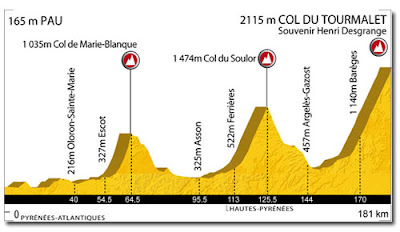
Stage 17: Pau - Col du Tourmalet - 174 km (pictured above)

Km 57,5 - Col de Maris-Blanque - 9,5 km climb to 7,5 %
Km 118,5 - Col du Soulor par Ferrières - 22 km climb to 4,9 %
Km 174 - Col du Tourmalet par Barèges - 19 km climb to 7,4 %


Some History

I love cycling history, and few races have more drama filled days than the Tour. So it was in 1909 when first Director Henri Degrange was looking for the same thing every director since has sought - a way to just spice things up a bit. Tricky bit for the riders of the coming 1910 edition of La Grande Boucle was that Degrange had every Col and goat track in the land to choose from - nothing had really been climbed yet, his palet of pain was wide open, so why not choose the most painful? The Tours to that point were largely left to the rouleurs (those tireless fellows of the rolling lowlands) - the 2010 Tour will give then their due: the roly-poly hills of Medoc, Bordeaux, the infamous cobbley
“trouée” (the trench), in the northeast near Arenberg (where stage 3, Wanze-Arenberg Porte du Hainaut, will include 7 cobbled Paris-Roubaix sectors over a total distance of 13.2 km). But a century ago this coming year life in the young peloton was about to change - and it has since.

In the summer of 1910 riders must have approached the much anticipated
geant Tourmalet with some trepidation. Octave Lapize (the eventual winner of the Tour) reached the top of the Tourmalet first, followed by Gustave Garrigou. Garrigou was the only cyclist to reach the top without dismounting and received an extra 100 francs.

This next July as the boys cross over the summit (2,115 m / 6,939 ft, it is the highest road in the central Pyrenees) climaxing the initial fun ride up the east side on stage 16 (the easy side) they will be greeted by the large statue of Octave Lapize gasping for air as he struggles to make the climb - oddly it's a memorial to Jacques Goddet, director of the Tour de France from 1936 to 1987; why not poor Lapize? He's the poor schmuck who did all the work. The best part of stage 16 is whizzing down off the Tourmalet, with every rotation of the wheels, is a reminder - "Crap, we have to come back up this side!"

I've only seen the west side in a cold rain; a cold rain from behind the windscreen, following my stubborn friend Todd as he descended as cautiously as I have seen him come off any summit. If July 20th is anything like "our" Tourmalet, I can't fathom racing off that monster - yet the
maillot jaune will likely hang in the balance and it will be full on, like wheeled falcons stooping for golden glory.

The
geant Tourmalet has been crossed 73 times since Degrange tossed it in there in 1910 based on a trusted collegue's appraisal - After reaching Barèges (with the help of rescuers), Steines sent a telegram to Degrange: "Crossed Tourmalet stop. Very good road stop. Perfectly practicable." , after mushing to the summit in the snow. (Even the Vuelta a España has crossed the pass several times.) In first year the poor peloton, all 110 of them that started dwindled quickly, but the monster was the main culprit - only 44 near dead riders finished Degrange's little experiment. The Tour now had Grimpeurs!

Three years later, 1913, comes one of the most painful and retold acts of this play. The famous cyclist, Eugène Christophe, known as 'le Vieux Gaulois' (the Old Gaul), worked feverishly in village of Ste Marie-de-Campan to repair the front-wheel fork of his bicycle there after being struck by a car during the descent of the Tourmalet. Director Degrange's rules were strictly enforced and prevented him from obtaining assistance and he had to walk 15 km to do the repairs himself. While in the forge he solicited the "assistance" of a young boy to work the bellows - on top of the four hours he lost in repair the unsympathetic King of the "murders" tagged him with a 10 minute penalty. This gave the leading pack an advance of four hours and Christophe's dreams of securing the
maillot jaune went up in the forge's fires.

When the lads-n-lycra ascend the west wall it will only be the second time since 1974 that a stage finishes on the Tourmalet - and it may yet be the most dramatic final act in "Death by Tourmalet" since it was first crossed a century ago.

In the 'modern era' have there been tougher Tours than 2010? One thins is for certain - "Death by Tourmalet" should separate the men from boys, and the rest from the will to go on.

Inside Cycling - Perspective on the 2010 Tour route

By VeloNews' John Wilcockson

Slide show of the Tourmalet


Wednesday, October 14, 2009

F R A N C E.... the final frontier

These are the voyages of Capt. Prudhomme and the starship ASO, boldly going where no media hyped cycling event has ever gone before...

Just hours ago they unveiled the 2010 TdF route, including the much anticipated hundredth anniversary of then director Henri Degrange's near death march up the muddy goat track climb of Col du Tourmalet. In 2010 they lads in lycra will get tortured by Tourmalet twice - stock up on your high altitude blood supplies boys.

One day, I'm going to go to the Tour de France route unveiling ceremony for myself - just to see in person how ridiculously overhyped this event can be. Until then check out this bit of video-whizbangery...


And for a more practical look - these from VeloNews and Cyclingnews:
2010 Tour route unveiled
2010 Tour de France: a taste of the classics
Rider's reactions to 2010 route