This is wonderful - time to laugh at ourselves!


What Are Reps in Workout? – Beginner Basics
14 hours ago
 It was sunny yesterday in the Alps, I got over the first big summit, the Col du Madeleine, at nearly 2,000 meters high the scenery was breath-taking, I felt in great shape, but it was early, as I was being told. I hung on through a long plummeting downhill into the valley below, in the distance was where we were headed and another 90 mins, most of it heaven bent. I knew it was there that I would be "opening up my account" and "hoping to avoid being dropped". I just had to "shut [my] eyes, suffer and grab that wheel".
"Phil's earliest ambition was to be a zookeeper. But in 1967, he got a job as a cub reporter with Cycling and Mopeds magazine, in London. Before long he'd moved on to ITV, where he landed in front of the camera one day in 1978, reporting on a London bike race, and discovered he was good at it. In short order, ITV made him their main commentator for the Tour, and over the next few years his verbal acrobatics impressed enough network suits that he was asked to report on cycling for the BBC at the 1984 Summer Olympics, in L.A. By the nineties he was covering skiing at the Winter Games for CBS.Phil & Paul have helped World Cycling Productions become a bit richer off of me - the DVD collection now stands at nearly a complete decade, plus the historic stuff. I know their overlapping voices so well now that I catch myself saying their lines just before they do - a bit spooky sometimes, especially when I'm "coming down the finishing straightaway like a grand prix motor car" and gasping "like a goldfish".
Paul began as a cyclist as well but stuck with it a little longer than Phil. He suffered through seven Tours (his best finish was 70th, in 1978) and was an excellent sprinter, he says, but in the mountains he couldn't keep up with the likes of five-time French champion Bernard Hinault. Still, he won two British national championships, in 1986 and '87, and became something of a multitasker: In 1986, while he was still racing professionally, the UK's Channel 4 hired him to help Phil manage the herculean task of covering the Tour. The two have been a team ever since, even with Paul's periodic extracurricular activities, like working as the PR director for Armstrong's Motorola team in the mid-nineties and, in 1999, lending help as a translator when Lance was having trouble with the French media during his first Tour win. But his line-crossing days are over; now he splits his time between covering cycling and running a gold mine in Uganda, where he and his family live."
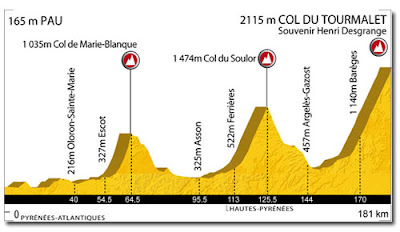 Well, I drank the cool-aid, or Gatorade, or Accelerade, or what ever liquid that is that makes us spend a small fortune to torture ourselves. My registration is in. I've bought the "package", including the 220 Euros for official "non-Residence in France" entry fee from Cyclomundo. As Goethe is quoted saying, "until one is committed there is hesitancy". Well hesitate no more, 2010 I'm tackling the Col du Tourmalet with 8,500 committed (or should be!) nut-cases - bring on the L'Etape du Tour!
| Col de Marie-Blanque | 9,5 km at 7,5% |
| Col du Soulor par Ferrières | 22 km at 4,9% |
| Col du Tourmalet par Barèges | 19 km at 7,4% |
 Sleep-in 'till 6, listen to NPR Morning Edition, return emails, just reconnect with the world, but no --- instead I wake at 5 AM and lay there, my brain says rise, stagger to the remote and say good morning to Phil (Liggett) and Paul (Sherwin). As they get settled, telling me what I have heard a dozen times, but somehow I feel hooked like a cycloaddict needing to hear it said one more time, maybe somewhere inside I know I have limited time for a fix, I fill the water pot to boil and get my cuppa Earl Grey tea started. But it's Day 24 of the Tour's 23. It's the morning after. It's the coming down, going cold turkey, slamming on the breaks. It's like dropping a chain a 15% climb, all forward progress ceases, your brain sends a warning - "clip out NOW!" It's Tour de France withdrawals.


